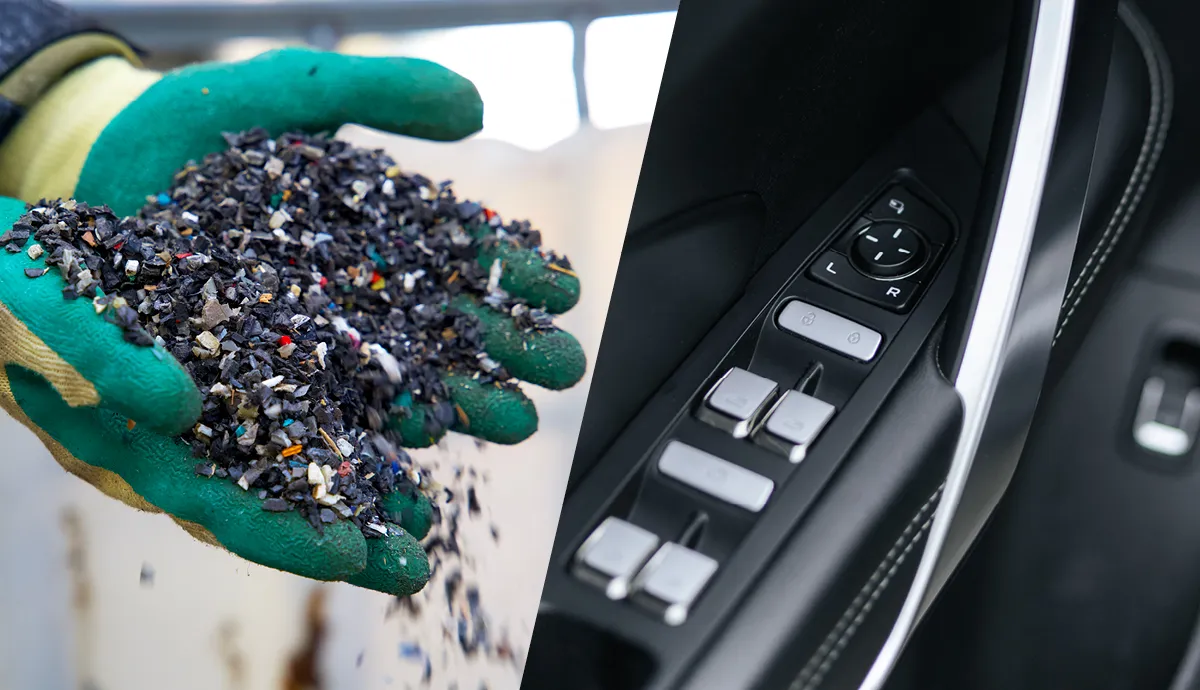
As the automotive industry accelerates its shift toward circularity, recycled plastics are taking center stage. Converters and original equipment manufacturers (OEMs) globally — and particularly in Europe — are under increasing pressure to incorporate post-consumer recycled (PCR) content into vehicles. This is not just a matter of environmental responsibility. From 2023, the European Union’s new End-of-Life Vehicles (ELV) regulation requires incorporating at least 25% recycled plastic into automotive parts, with 20% of that share coming from ELVs or from parts and components removed from vehicles during their use.
Meeting Automotive Recycling Mandates: Overcoming Color Challenges with Recycled Polymers
Apr 21, 2026
Article Contents
Why Is Color Consistency a Challenge with PCR in Automotive?
For automotive OEMs and their supply chains, these regulatory changes present both an opportunity and a challenge. Many brands have set ambitious sustainability targets and developed internal approval requirements for PCR materials. The big question is: how do you deliver consistent, high-quality parts that meet strict color and technical requirements when working with PCR?
The biggest hurdle for converters and brands is the inconsistent quality of PCR resins. Automotive color targets are notoriously tight, with narrow tolerances and strict technical demands. Lot-to-lot variability in PCR—caused by different sourcing outlets—can make it tough to meet these targets consistently. Even a small shift in recycled resin quality can affect color.
What’s the Solution for Coloring PCR-Based Parts?
A tailored color masterbatch, developed for the unique characteristics of each PCR grade, is key. Every PCR resin is different and needs a customized approach. This doesn’t mean starting from scratch each time. With the right approach and strong collaboration across the supply chain, the process can be streamlined.
How Does Avient Support Color Consistency with PCR?
At Avient, we work alongside the entire value chain—PCR suppliers, compounders, and Tier 1s—to help deliver consistent quality that meets OEM requirements. Here’s how our workflow addresses the challenge:
- PCR Characterization: We use refined methods to predict lot-to-lot variation, helping customers select the best PCR for their color targets
- Coloration Strategy: Drawing on deep material knowledge, we develop the most effective coloration strategy for each PCR grade
- Production and QC: Our manufacturing and quality control (QC) processes are tuned to the specific needs of automotive customers
- Color Evaluation: Our color-matching labs use specialized molds and methods that replicate OEM color evaluation processes
What Factors Impact Color in PCR-Based Automotive Parts?
Several variables influence the ability to achieve and maintain color consistency in PCR-based parts:
- Resin Quality: Color tone, color strength, recycled content percentage, feedstock origin, and the presence of additives or fillers
- Target Color Specificity: Shade, lightness, brightness, and special effects
- Assessment Methods: Feedstock selection, color assessment, and control of lot-to-lot variation
- Manufacturing Process: Use of color compound or direct injection of the color masterbatch, processing parameters, and equipment
- OEM Specifications: Color tolerances, mechanical and surface properties, and other individual specifications
Ready to Meet the Challenge?
Incorporating recycled polymers into automotive applications doesn’t have to mean compromising on color or quality. By using a tailored color masterbatch and a structured workflow, compounders and converters can achieve color consistency in PCR-based parts— helping OEMs meet sustainability requirements while delivering reliable performance.
Looking to simplify your transition to PCR in automotive? Connect with Avient’s automotive color experts to see how our tailored solutions support consistent, high-quality results.